
From Equipment Selection to Production Startup
Installation, relocation, and line startup take a coordinated plan. D.E.L.L. PET brings process expertise to every stage — from equipment decisions to production handover.
Equipment planning · Installation & relocation · Startup & qualification
How We Plan Your Project
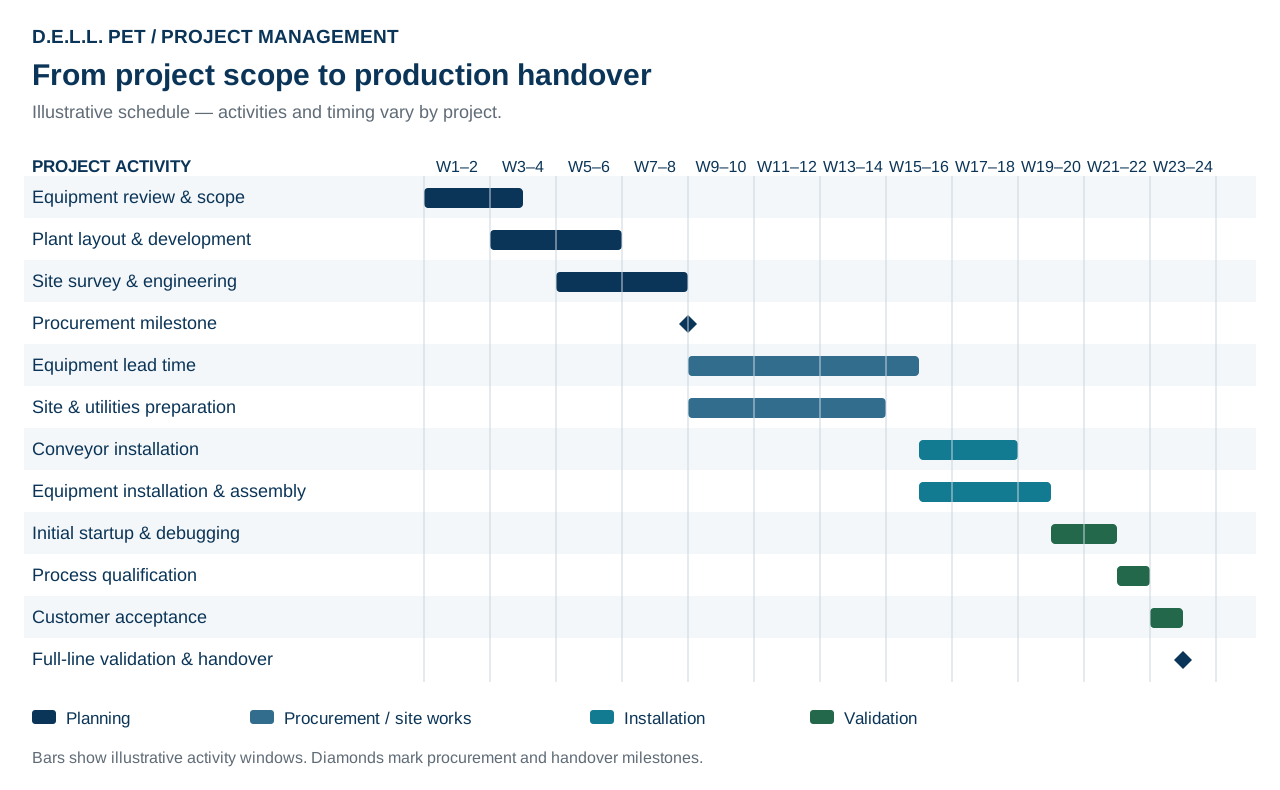
Equipment lead times, site preparation, installation, and qualification are coordinated in one project schedule. This illustrative example shows how the work is organized; timing is tailored to each project.
Project at a Glance
Illustrative 24-week plan. Activities overlap; actual timing is tailored to your project.
- Weeks 1–8: PlanningEquipment review, plant layout, site survey, and engineering.
- Weeks 9–15: Procurement & Site PreparationProcurement milestone, equipment lead time, and utilities preparation.
- Weeks 16–19: InstallationConveyor installation and equipment assembly.
- Weeks 20–24: Startup & HandoverStartup, process qualification, customer acceptance, and full-line handover.
Installation & Relocation Experience
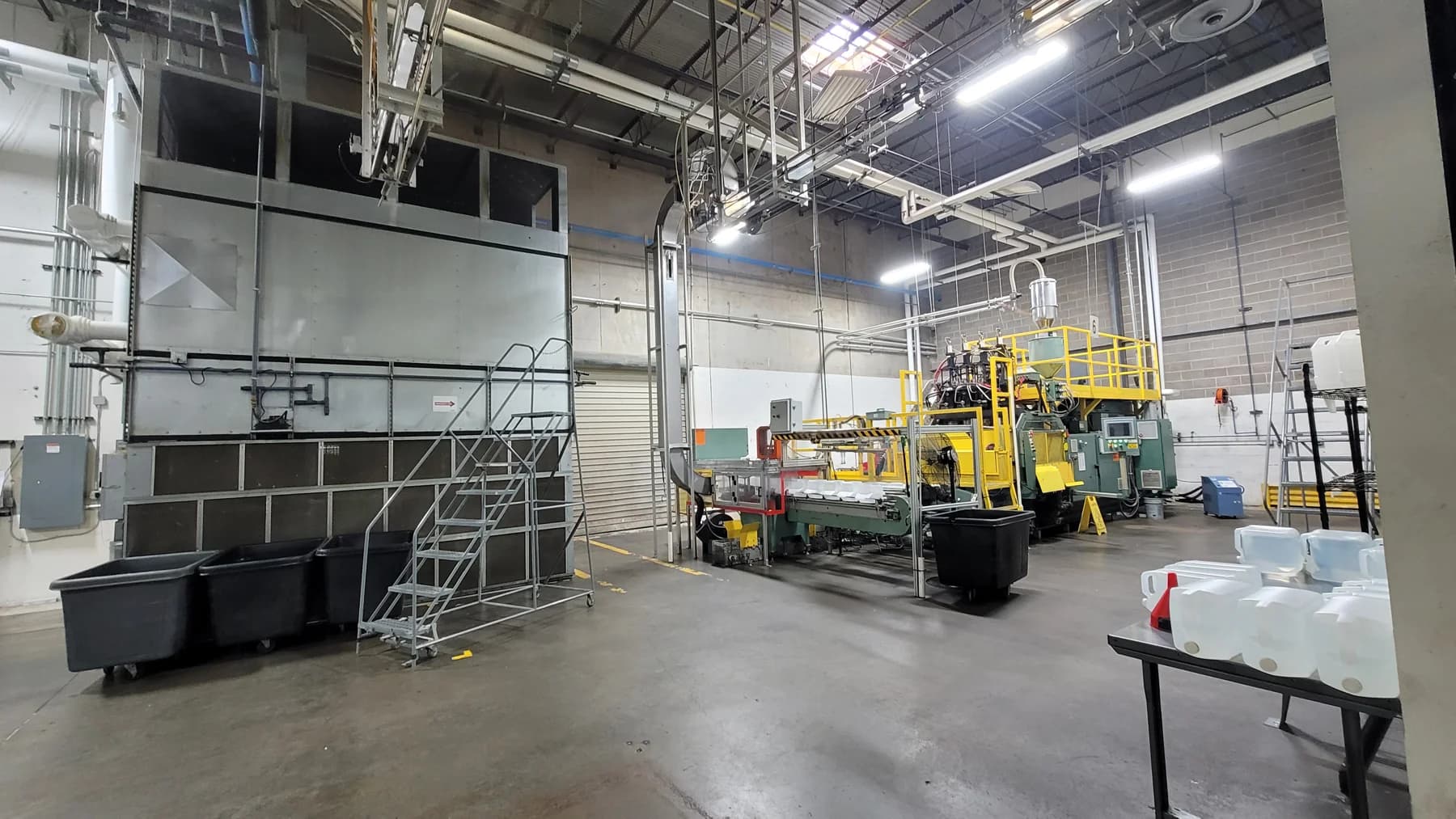
Photos from equipment installation, transport, and manufacturing facilities. Select a photo to explore the gallery. Use the arrows to browse equipment preparation, handling, transport, and facility views.
Real Documents From Our Projects
Two working documents from D.E.L.L. PET projects. Names, plants, dates and other identifying details are blacked out; the report is shown as written, and the resource plan is rebuilt from its spreadsheet as a table.
Incident Report: Dropped Extruder Head
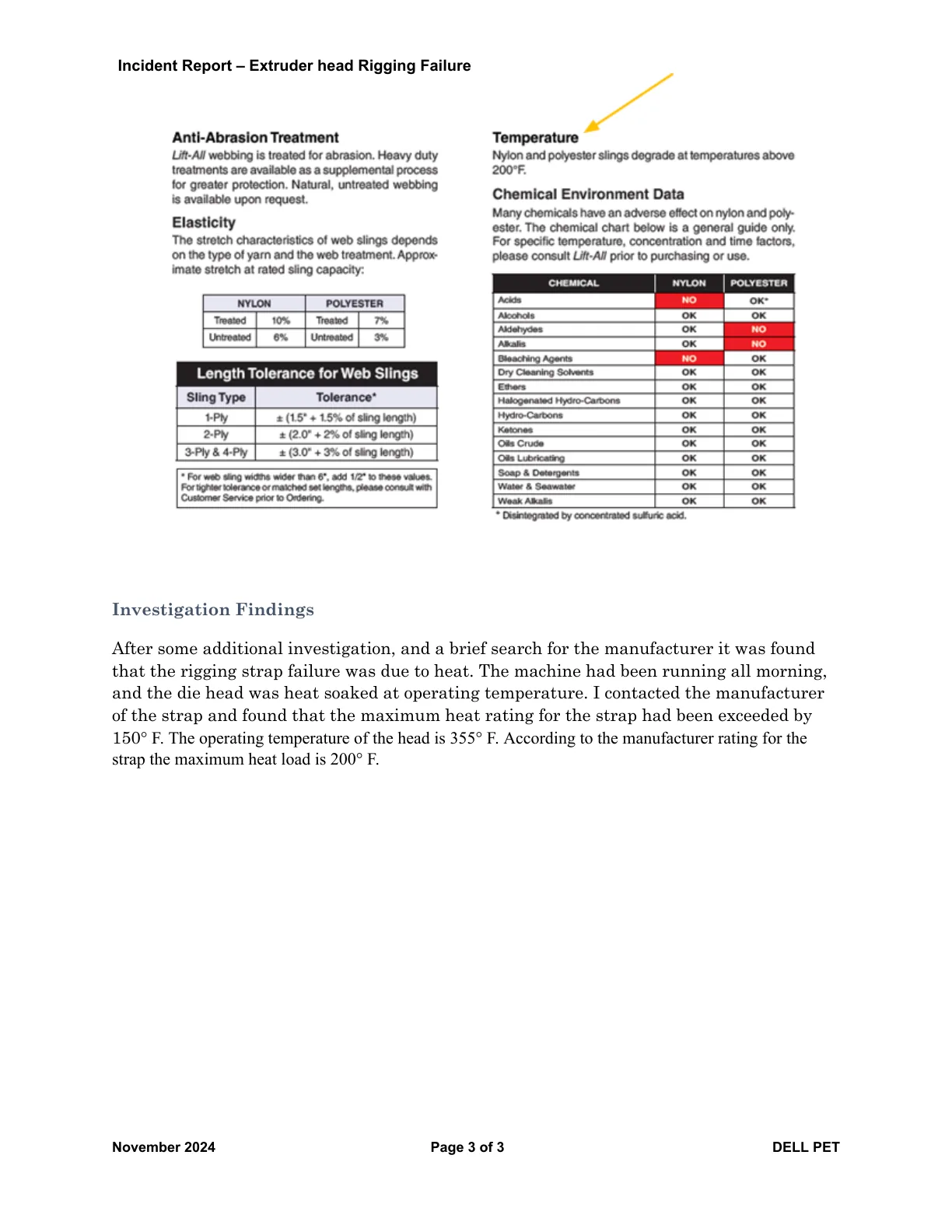
When a rigged extruder head dropped during a nozzle repair, the report traced the failure past the obvious answer: the slings were correctly rated for the load, but the heat-soaked die head was 150°F over the slings' temperature limit.
Read the report as text
Incident
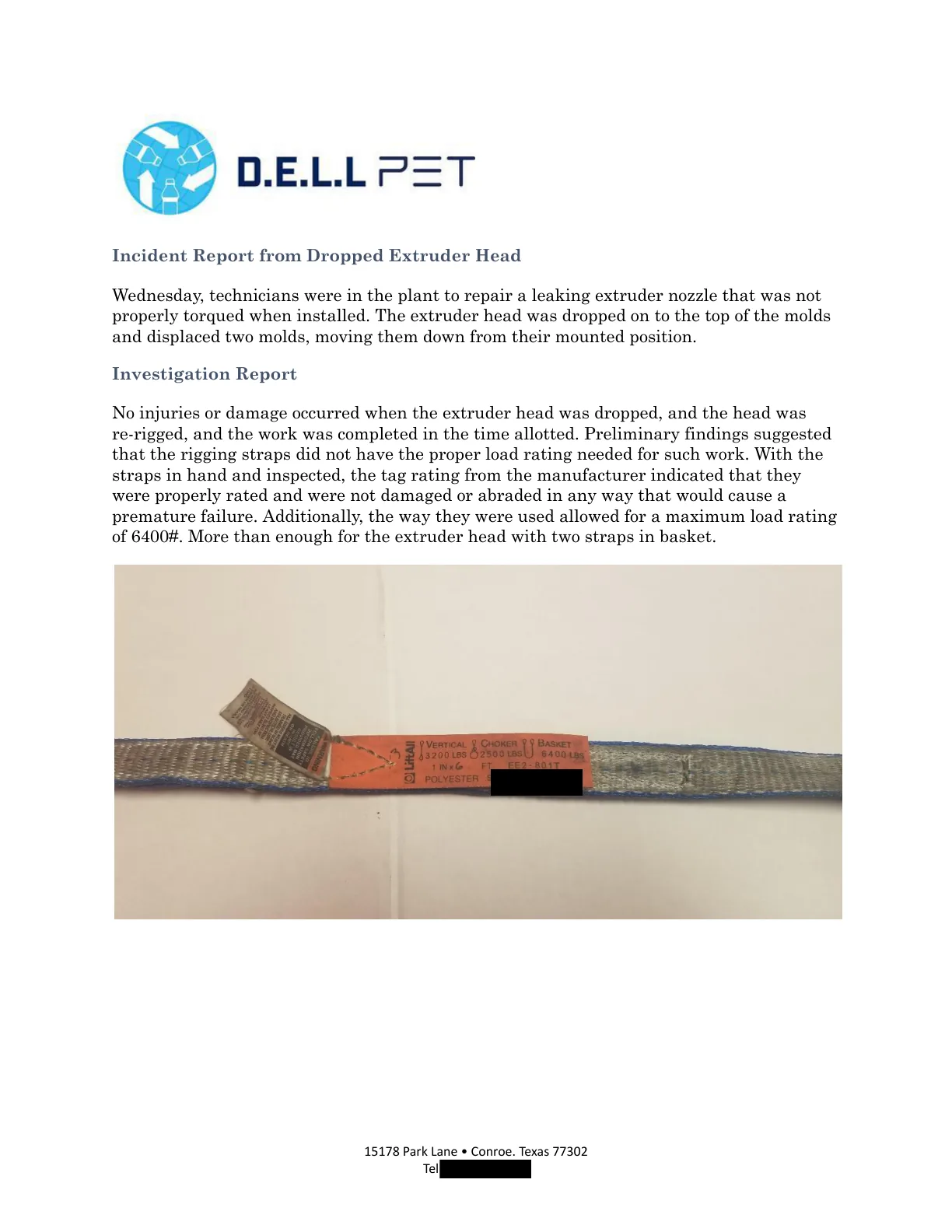
Wednesday, technicians were in the plant to repair a leaking extruder nozzle that was not properly torqued when installed. The extruder head was dropped on to the top of the molds and displaced two molds, moving them down from their mounted position.
Investigation Report
No injuries or damage occurred when the extruder head was dropped, and the head was re-rigged, and the work was completed in the time allotted. Preliminary findings suggested that the rigging straps did not have the proper load rating needed for such work. With the straps in hand and inspected, the tag rating from the manufacturer indicated that they were properly rated and were not damaged or abraded in any way that would cause a premature failure. Additionally, the way they were used allowed for a maximum load rating of 6400#. More than enough for the extruder head with two straps in basket.
Manufacturer Data
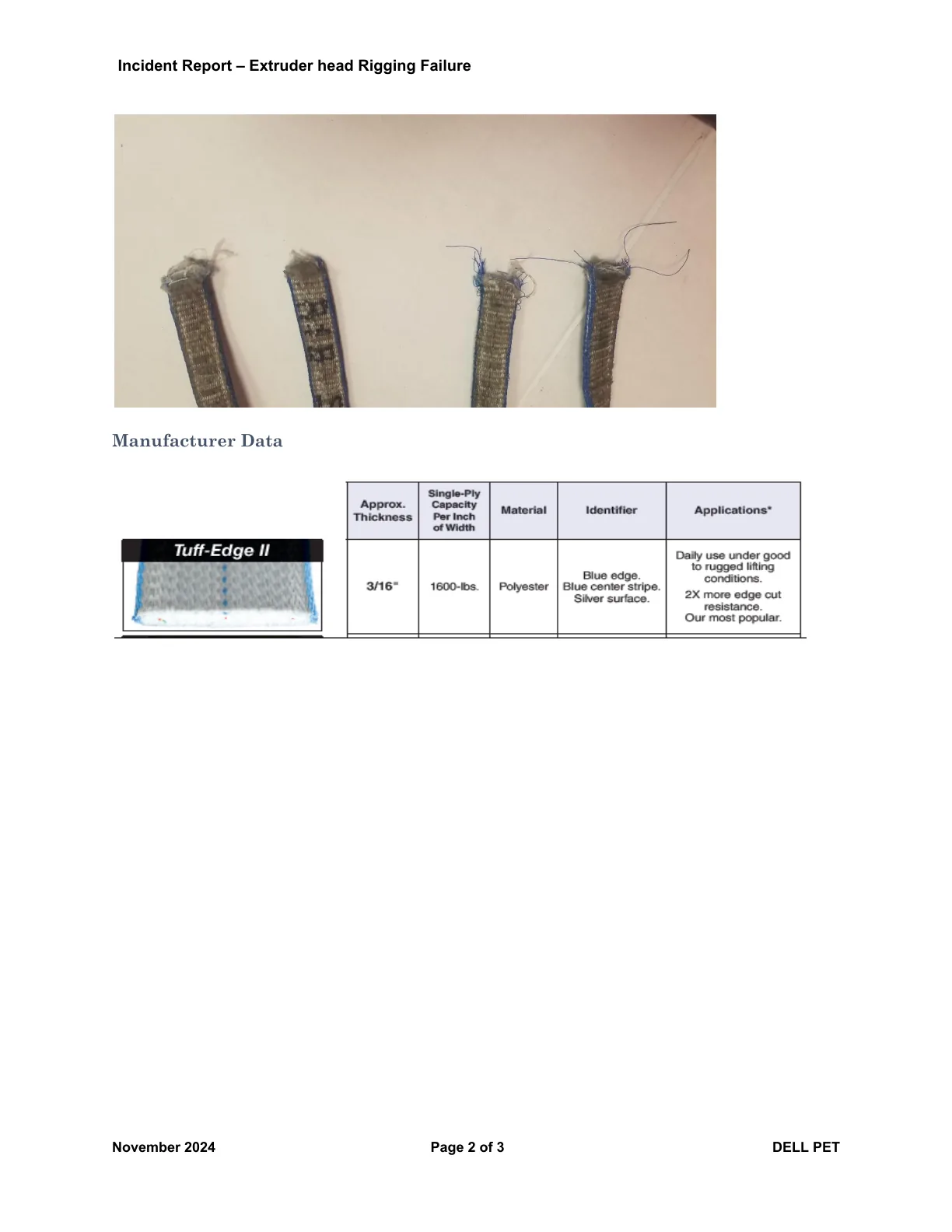
Tuff-Edge II: approximately 3/16" thick; single-ply capacity 1,600 lb per inch of width; polyester; blue edge, blue center stripe, silver surface. Manufacturer's catalog: nylon and polyester slings degrade at temperatures above 200°F.
Investigation Findings
After some additional investigation, and a brief search for the manufacturer it was found that the rigging strap failure was due to heat. The machine had been running all morning, and the die head was heat soaked at operating temperature. I contacted the manufacturer of the strap and found that the maximum heat rating for the strap had been exceeded by 150° F. The operating temperature of the head is 355° F. According to the manufacturer rating for the strap the maximum heat load is 200° F.
Resource Plan Example
The example tab of the resource-planning template a project lead uses alongside the Gantt chart to settle who is on site, and on which day, across an eight-week, two-plant project.
How the template is used
- Template should be used for planning resources during a project.
- Project Lead will populate anticipated resources (add/subtract resources as needed on the template).
- If there are various projects within a plan, color code and populate as noted in the example plan.
- Recommend using MS Project for Gantt w/resources noted - but fine tuning resource plan with this template.
- Project Lead to review with plant and publish 2 weeks after PEA approval - so resources can be identified/scheduled early in the planning phase.
Key dates
- redacted line end of production: redacted
- redacted line end of production: redacted
- redacted line ready for molds: redacted
- redacted line ready for bottles: redacted
- redacted line qualified: redacted
On site TravelingScroll sideways on small screens.
| Resource | Daily schedule | Days |
|---|---|---|
| Engineering | ||
| redacted | 1 day on site; week 2 | |
| Project management | ||
| redacted | 15 days on site, 6 travel; weeks 1–5 | |
| Process, qualification and startup | ||
| redacted | 9 days on site, 3 travel; weeks 2–4 | |
| redacted | 6 days on site, 2 travel; weeks 3–4 | |
| redacted plant assistance | ||
| Mechanic – redacted | 9 days on site; weeks 1–2 | |
| Mechanic – redacted | 9 days on site; weeks 1–2 | |
| redacted plant assistance | ||
| Mechanic – redacted | 17 days on site; weeks 1–4 | |
| Mechanic – redacted | 5 days on site; week 1 | |
| Operator 1, 1st shift – redacted | 28 days on site; weeks 2–8 | |
| Operator 2, 1st shift – redacted | 12 days on site; weeks 3–5 | |
| Operator 1, 2nd shift – redacted | 16 days on site; weeks 5–8 | |
| Operator 2, 2nd shift – redacted | 4 days on site; week 5 | |
| Operator 1, 3rd shift – redacted | 16 days on site; weeks 5–8 | |
| Operator 2, 3rd shift – redacted | 4 days on site; week 5 | |
| Temp, 1st shift | 16 days on site; weeks 3–6 | |
| Temp, 2nd shift | 8 days on site; weeks 5–6 | |
| Temp, 3rd shift | 8 days on site; weeks 5–6 | |
| Quality – redacted | 4 days on site; week 4 | |
| Vendors | ||
| redacted (piping contractor) | 10 days on site; weeks 1–3 | |
| redacted (mechanical contractor) – plant A | 9 days on site; weeks 1–2 | |
| redacted (mechanical contractor) – plant A | 9 days on site; weeks 1–2 | |
| redacted (mechanical contractor) – plant B | 9 days on site; weeks 1–2 | |
| redacted (electrical contractor) – dehumidifier | 6 days on site; weeks 1–3 | |
| redacted (electrical contractor) – wheel and downstream | 9 days on site; weeks 1–2 | |
| Trimmer OEM | 4 days on site; week 3 | |
| Reamer OEM | 4 days on site; week 3 | |
| Packaging system OEM | 4 days on site; week 3 | |
Project Phases
A structured path from initial evaluation to a validated, running line.
Evaluation & Feasibility
Machine evaluation and selection against your product mix and process requirements, and feasibility review for new lines or facility changes.
Planning
Sequencing installation, utilities, and process requirements against your production schedule before equipment moves.
Installation & Commissioning
On-site support through equipment installation, relocation, and commissioning — including new-line startup.
Startup Validation
Process validation at target rates before the line is handed back to standard production.
What's Covered
Machine Evaluation & Selection
Assessing equipment options against your product and process requirements.
Installation
On-site coordination through equipment installation.
Relocation
Planning and executing equipment moves between facilities or lines.
New-Line Startup
Commissioning and process validation for a new production line.
Project management is closely related to One-Step & Two-Step Support for equipment-specific startups, and to Training for bringing a new team up to speed on a new line.
Meet Christopher Arnold, MBA, General Manager & Director of Projects.
Have a Project Ahead of You?
Discuss the scope and timeline with D.E.L.L. PET before equipment decisions are finalized.